Studying with neurodivergence
The roundtable at University of Bern that kicked off our activism in 2024
Date of publication (Blogpost): June 2024 | Author (Blogpost): Anne Halter, Editor (Blogpost): Andrea Indermaur
Follow along as our community members talk all about specifics of being neurodivergent students like last minute all-nighter sessions to finish a paper, excellent analytical skills, solo field trips to prevent overwhelm and more. Finally, you can hear all about our demands for improved disability accomodations at University of Bern.
Here you can either listen to the recording of the roundtable «Diversity in thinking: neurodiversity in everyday study life» in German or read about it in English below.
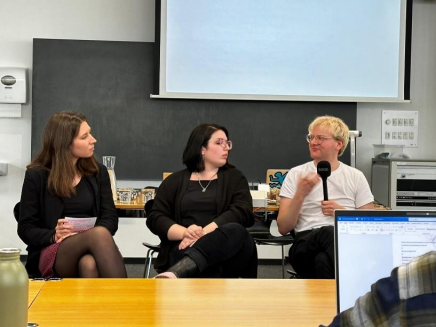
Image (left to right): Andrea, Charis & Louis
Structure and topics of the roundtable
• Personal experiences of being neurodivergent students
• Current experiances with Disability accomodations at the University of Bern
• Our demands to improve disability accomodations at the University of Bern
• Public discussion & vegan Aperitif
Introduction
The roundtable kicked off with an introduction by Ricarda and Gina, the hostesses of the podcast “IRRSINNIG”. They present the following historical milestones as the motivation behind the event:
On occasion of the National Action Days for Disability Rights (15th May-15th June), celebrations are taking place all over the country in honour of the 20-year anniversary since the Federal Act on the Elimination of Discrimination against People with Disabilities entered into force in Switzerland (DDA, 2004). But 2024 marks a second milestone: this year is the 10 year anniversary of Switzerland’s ratification of the UNO Convention on the Rights of Persons with Disability with the goal, among others, to secure equal human rights to persons with disabilities (CRPD, 2008).
The topic of the roundtable is neurodiversity at the University of Bern. The term neurodiversity is broadly defined as “neurobiological diversity”. Under this umbrella term, human brains belong to either of two categories: neurotypical brains, or ones that are neurodivergent, meaning they have differences in their neurobiological functioning that can fall under the categories of ADHD (Attention Deficit Hyperactivity Disorder), dyslexia, hypersensitivity, the autism spectrum, etc. Roundtable participants from the neurodivergent dinner association draw attention to the fact that this list is not definitive, and that the term “neurodivergence” is constantly being broadened to account for more variants.
Four members of the Neurodivergent Dinner are present at the roundtable. Their monthly dinners as well as other events are run by the community for the community and aim to provide a safer space for people who identify with the term “neurodivergent”, regardless of whether they’re questioning, medically or self-diagnosed: all are welcome. This includes students of all Bernese tertiary education institutions*, for example, the University of Bern, the PH (Bernese School of Pedagogy) and more, as well as their alumni. The association also organises other events for students to meet like-minded people, exchange experiences, and participate in fun activities (Neurodivergentes Znacht, 2024).
(*We now also welcome students and alumni from any schools of tertiary education, not just from Bernese Schools of tertiery education. For more info, see our statutes in the websites footer below).
After the introduction of the association, the members representing the group introduce themselves by name, type(s) of neurodivergence, and special interests (an autistic trait) or hyperfixations (an adhd trait):
Andrea, 23, is the founder of the neurodivergent dinner. She has ADHD and strongly suspects she’s on the autism spectrum as well*. Her special interests include social justice and, as of recently, gardening.
(*she got her autism diagnosis a few weeks later)
Marc is an assistant at the University. He studied law, is autistic, and has an interest in politics, history, – loads of topics! He hopes to represent the perspective to the roundtable of a person who is already working.
Charis studies social sciences and is currently writing her bachelor’s thesis. She is especially interested in neurodivergence in women, how it shows up in their daily life, and the brain structure of neurodivergent people.
Louis is majoring in archaeology at the University of Bern. He describes his special interest as usually being “the exact topic which I’m not studying in depth at that moment”.
(Please note: a fifth speaker wishes to remain anonymous. Their info and statements have therefore been excluded from this blogpost.)
Personal experiences
Next, the speakers are asked to describe what makes them neurodivergent. For Louis, it started with the very first written assignment in his studies. “I procrastinated, didn’t know where to begin, and wrote the paper in one night. Then I went straight to the counselling office of the university.” This elicits a couple of laughs from the audience. Then, he explains how he was diagnosed with both autism and ADHD but has recently begun to wonder if it’s actually just autism without ADHD.
For Andrea, her strong sense of justice* drives her to try and make the world a better place. She describes herself as spontaneous, creative, thinking outside of the box, and a problem solver who wants to get to the bottom of everything.
(*Important nuance added by Andrea – having a strong sense of justice doesn’t necessarily mean that one is correctly identifying right from wrong or better at it compared to neurotypicals!)
Stumbling across the term “neurodivergent” on the internet had been the common experience among the group. While Andrea suffered an exhaustive depression at the end of high school and experienced executive function struggles, Charis points out that her diagnoses are ones that don’t show up first thing on Google. “You know you’re neurodivergent, right?” said a friend to her last year. Her reply: “Uh, no, how long have you known this?”
Louis got sent a long video on autism by a friend. It resonated and led him to ask for an autism assessment during the last session of his ADHD assessment. The long video helped, he remarks, while he finds that he often can’t really relate to short-form video content.
The podcast hostesses lead into the topic of accommodations by critically picking up on the word “disorder” in the diagnoses’ titles just mentioned – Who is disordered (in the German sense of “Störung”, “gestört”, or bothered)? And how? Food for thought…
The accommodations process at uni is a controversial one, on top of being a massive energy drainer. Multiple voices strongly criticise the university’s requiring a student to disclose their diagnosis, as this violates the principle of medical confidentiality (FOPH, 2020). At best, so the participants explain, they knew to ask for specific accommodations, and the professors granted them these without further hassle. At worst, the process was lengthy, they struggled to find information about it and accommodation options, and when talking to teachers, were simply told “no”.
Charis reads a story aloud from a survey conducted prior to the roundtable. Students of University of Bern had been asked to share their experiences. In this particular story, a student criticized the decentralised nature of the accommodations process. In their case, they were instructed to go to their professors individually to find solutions for each course, with the person in charge of accommodations saying: “We try to keep the process as unbureaucratic and straightforward as possible.” Ironically, the student spent two days compiling an informative document for their institute, as the faculty had no prior knowledge about or experience with neurodivergence. While they were lucky and their professors actively read up on neurodivergence, later on, uncertainty at both the student and the professor level caused difficulty in coming up with accommodations, as well as knowing which ones were allowed within the Uni’s vague framework. Finishing the story, Charis says that the wishes of the group concurr in that there needs to be more awareness among students, but especially professors, to reduce the organisational and energetic workload on neurodivergent students, as well as minimise uncertainty and the resulting stress.
Next, Louis highlights the benefit of his studying at a small, open-minded institute that doesn’t require the full formal accommodations procedure. Yet, he explains, being granted informal accommodations involves figuring out each course anew and not having a written agreement to rely on. In his studies, field trips are part of the curriculum. He finds these very stressful due to the amount people and lack of a place to retreat to for some peace and quiet. On top of that, he continues, each of his courses are different (in terms of structure, content, type and form of evaluation etc.), and he might struggle with a particular aspect in one, but not have those difficulties in another. He concludes that each semester, the process of talking to professors individually has to be started anew.
In Andrea’s case, her request for intermittent deadlines in the paper writing process was turned down by a professor, for the reason that they are the evaluating person, and therefore can’t see her writing in advance. This doesn’t make sense to her. “To show just how easy it could be”, she quotes, “I had another course where the corresponding professor said “yes, no problem” to intermittent deadlines. Granted, that professor is in the process of getting an ADHD evaluation themselves.”
The discussion moves on to the following question: “The accommodations exist to overcome neurodivergent students’ system-induced disadvantages and grant them equal access to studying. What are your strengths, where can you bring something special to the table?”
Andrea describes herself as being quite happy in her philosophy studies, as they require an ability to pick problems apart and interpret them. Her strong analytical skills are very useful here, although at times there are too many possible interpretations which can lead to overwhelm. She struggles with narrowing something down, like choosing a topic for a paper. “But when I am interested, I can hyperfocus and spend ages on stuff, maybe even too long, as I sometimes forget to eat”, and chuckles go around the room. The audience seems to resonate with this experience.
As for Louis, he is excellent at finding gaps in the existing research. He can often help friends in need and send over an entire stack of papers regarding a specific topic.
Finally, the experience of students seeking accommodations at the systemic level is discussed in conjunction with the aforementioned survey responses. Louis is handed the microphone. He tells the story of someone who had no issue getting accommodations in their minor, whereas in their major, they missed their appointment. “They were supposed to make another appointment”, he says, “but again, it is precisely the neurodivergent students that do not have the capacity, and who struggle with organisation and keeping track of a schedule.” It is them, he continues, who are already struggling to deal with everything else that’s on their plate, so it’s nonsensical to require people in need of help to go through an additional, complicated process.
Marc, on the other hand, has a positive story to share about someone majoring at another department: According to them, they had an easy time finding the necessary information, the faculty was competent, and the student felt understood. As for their minor, they had not initiated the untransparent process yet and were slightly nervous about it.
Demands for the University of Bern
DISCLAIMER: These demands have since become more specific based on the results of our much larger survey in 2025 where we asked students how they experiance the access and quality of disability compensations at all Swiss schools of teriary education . You can read more about this on our page about our activism.
The discussion comes to an end with the group voicing the demands they’ve come up with for the University of Bern, as well as those submitted to the small anonymous survey prior to the roundtable by other students of the University of Bern. They highlight barriers that neurodivergent students still face and suggest improvements they hope to see in the near future. In no particular order, these are:
- A single, ideally peer-run and central contact point where neurodivergent students can access help and delegate the accommodations process as much as possible.
- Clear guidelines and more accommodations suggestions: What options are available? What accommodations does the university not grant? All the while keeping in mind each person’s individual disabilities, situation as well as the specifics of each course.
- The making available of Uni-wide podcasts for students unable to attend class due to mental and/or and kind of health issues, so that they may catch up on the material to the same extent that students able to attend class are. No, using slides and literature is not equivalent to hearing the professor’s explanations. However, standardisation of the podcast process can lift the burden off professors to do it periodically and individually.
- When introducing themselves at the start of a new course, professors should make students aware of the existence of accommodations and encourage them to talk to them if needed.
- Mandatory further training for professors about neurodivergence. It can be short but informative. Even a newsletter would be cheap and relatively low-effort to implement, as most of these demands are. Knowledge needs to be widespread. Because the following statement holds true: Explanatory work is work, and costs students energy which they can’t spare.
- A quiet place to retreat to, especially at lunch time, when neurodivergent students have to choose between eating something in a loud, crowded place and risk overstimulation, or not eating anything.
- Depathologisation of neurodivergence at uni and within courses, meaning the description of neurodivergence through positive and neutral aspects, and rejection of negatively connotated phrases such as “delayed development”, “underdeveloped”, “below-average skills” etc.
Public discussion
The roundtable is opened to the audience. Instantly, many hands are raised, and an animated discussion follows. The room is brimming with people eager to share their experiences and comment on the matters discussed. The representative from the Office for Equal Opportunities speaks up: “The matter of granting accommodations is a process handled by each faculty individually.” As such, the streamlining of the accommodations process seems unlikely at present. But the representative goes on to thank the participants for their inputs, as they have given her much to think on. She has been taking notes throughout the discussion. Other students comment on the demand of centralisation of the accommodations process and highlight how important it is for professors to be flexible. They fear that centralising it would undermine the individuality of students’ needs. The consensus remains, however, that the current situation is unmanageable for neurodivergent students and professors alike.
The forced disclosure of diagnoses to the University is the next point that is hotly debated. After some time, a woman raises her hand. She introduces herself as a professor of forensic (i.e. legal) medicine and voices her disbelief at the current situation of mandatory diagnosis disclosure in order to receive accommodations. She asks whether neurodivergent people could benefit from having a template to fill out when asking for accommodations, and offers to create one. People thank her, and another audience member mentions the existence of a student-written template that will be shared with people at a later point. It is emotional to see a person of authority such as a professor this engaged in students’ wellbeing. There is energy and drive for chance in the room. More personal experiences are shared, and the productive discussion carries on. Perhaps others present can feel it too, this collective excitement at being surrounded by people who are alike, who understand.
In a closing statement, Andrea mentions that although the roundtable has spoken a lot about the accommodations process, there are a lot more issues to discuss around being neurodivergent at uni. “We briefly spoke about our individual strengths and how they help us in our studies. I’d like to add on that the University is structurally conceived with neurotypical people in mind. The given framework does not provide opportunities for neurodivergent people to live out their strengths. A minority of neurodivergent students is lucky and can apply their strengths to their specific studies, but for the majority of us this is usually not the case.” Afterwards, the hostesses of the podcast “IRRSINNIG”, the speakers and the representative from the Office for Equal Opportunities thank each other and the audience for the joint effort of the event. The door is opened, and one by one, hungry people file out towards the vegan apéro waiting on neatly arranged tables outside. Here, the conversation continues… *
(*Shortly after this roundtable, our inclusion work group is formed. Learn more about our activism by the inclusion work group here)
Sources
Bauer, J. (2024). Images 1 [Photos].
Convention on the Rights of Persons with Disabilities, § Article 3 – General Principles (2008). https://www.ohchr.org/en/instruments-mechanisms/instruments/convention rights-persons-disabilities
Federal Act on the Elimination of Discrimination against People with Disabilities, Pub. L. No. 151.3 (2004). https://www.fedlex.admin.ch/eli/cc/2003/667/de
Neurodivergentes Znacht. (2024, June 2). Herzlich Willkommen beim Neurodivergenten Znacht. Neurodivergentes Znacht. https://www.neurodivergentesznacht.ch/
Ricarda, & Gina. (n.d.). Neurodivergenz im Studium—IRRSINNIG meets Neurodivergentes Znacht.
Your Rights at the Doctors and in Hospital, § 5. Professional or medical secrecy (2020). https://www.bag.admin.ch/bag/en/home/medizin-und-forschung/patientenrechte/rechte arzt-spital/5-berufsgeheimnis.html
Zukunft Inklusion. (2024, June 4). 15. Mai bis 15. Juni 2024 Nationale Aktionstage Behindertenrechte. Zukunft Inklusion. https://zukunft-inklusion.ch/